WEEE Regulations UK: What Businesses Need to Know
A plain-English guide to the Waste Electrical and Electronic Equipment (WEEE) Regulations — the six categories, who has to register, producer compliance schemes, evidence notes, and what the 2026 DEFRA reforms change.
What is WEEE?
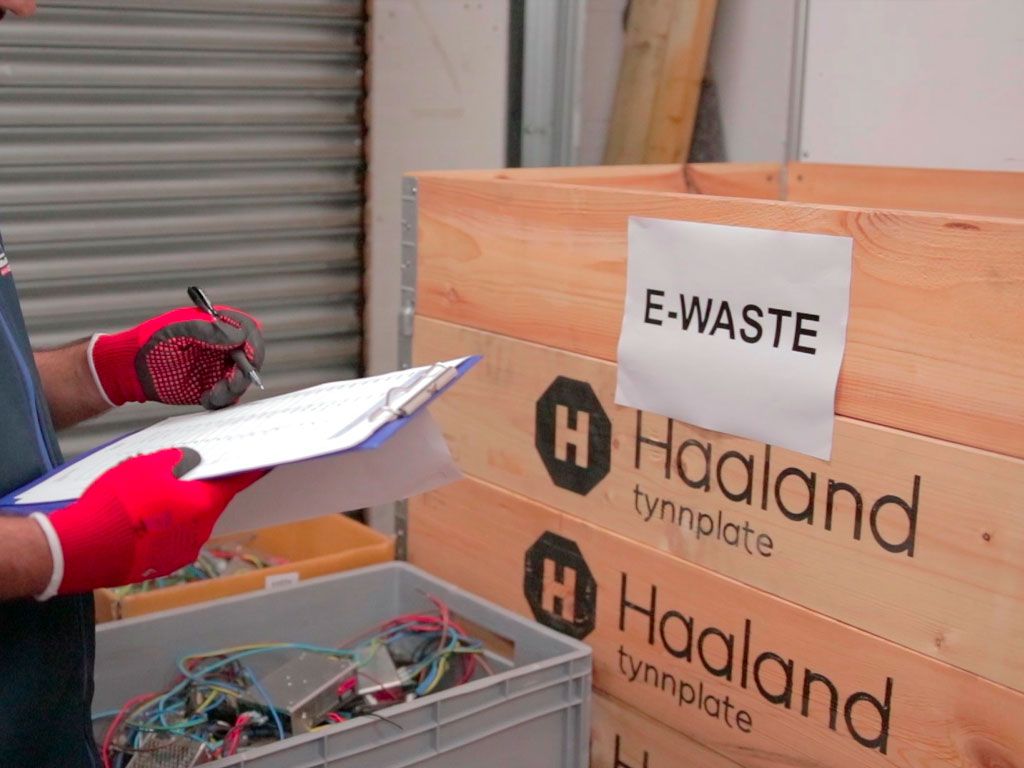
WEEE — Waste Electrical and Electronic Equipment — is anything with a plug, battery, or circuit board that is being thrown away. The UK WEEE Regulations 2013 implement the WEEE Directive and govern how that waste must be collected, treated, and reported.
If your business uses computers, monitors, servers, printers, or appliances, when they reach end of life they become WEEE — and you carry a legal duty of care to have them handled by a licensed carrier and treatment facility, with a Waste Transfer Note as evidence.
The Six WEEE Categories
Since 2019 the UK WEEE Regulations classify electrical and electronic equipment into six categories under an open scope.
1. Temperature exchange equipment
Fridges, freezers, air conditioning, and heat pumps — anything that uses refrigerants to heat or cool.
2. Screens and monitors
Any display with a surface area greater than 100 cm² — monitors, televisions, and display panels.
3. Lamps
All lamps and light fittings, including LED and gas discharge lamps.
4. Large equipment
Any EEE with an external dimension over 50 cm — servers, large printers, telecoms racks, and large appliances.
5. Small equipment
EEE with no dimension over 50 cm — small appliances, tools, toys, and consumer electronics.
6. Small IT and telecoms equipment
Phones, laptops, routers, keyboards, and peripherals with no dimension over 50 cm.
Producers must join a compliance scheme
If you manufacture, import, rebrand, or sell EEE into the UK market, you are a producer and must join an approved Producer Compliance Scheme (PCS). The PCS finances the collection and recycling of WEEE and reports your obligation data to the regulator.
Business end-users must dispose responsibly
If your business simply uses the equipment, you are not a producer and do not need PCS membership. Your obligation is the duty of care: use a licensed waste carrier, keep Waste Transfer Notes, and send WEEE to a permitted treatment facility.
Waste Transfer Notes vs evidence notes
A Waste Transfer Note (WTN) documents the handover of waste between holders and applies to every business that moves waste. An evidence note is issued by an approved treatment facility to a producer compliance scheme as proof that WEEE was treated — it only exists inside the producer compliance system.
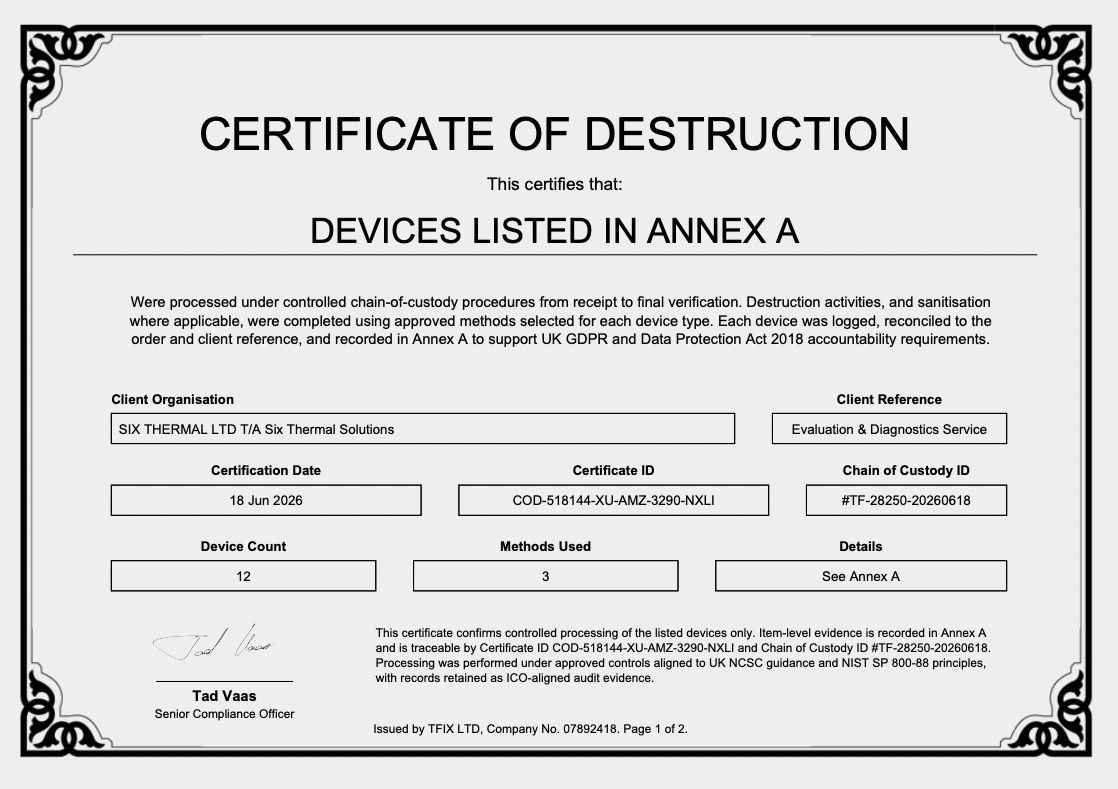
As a business end-user, the document you need to keep is the WTN, plus any certificates of data destruction for equipment that held data.
The 2026 DEFRA reforms
DEFRA has consulted on reform of the UK WEEE system, including how household and business WEEE collections are financed and delivered, with changes expected from 2026. While the final shape is still being finalised, the direction is toward more producer-funded collection of small WEEE.
For businesses, the practical advice is unchanged: keep your disposal evidence, use licensed carriers, and stay ready to adapt reporting as requirements evolve.
Related: digital waste tracking and the waste hierarchy.
How TFix helps you stay compliant
TFix is a licensed waste carrier and T11 WEEE treatment facility. We collect, treat, and recycle your WEEE under chain of custody, and issue Waste Transfer Notes and processing records for your audit trail.
Note: we are a treatment and collection provider, not a producer compliance scheme. If you place EEE on the market, you still need to join a PCS separately.
WEEE Regulations FAQs
What counts as WEEE?
Any electrical or electronic item being discarded as waste — from computers and monitors to appliances and lamps. The UK WEEE Regulations group it into six categories.
Do I need to join a producer compliance scheme?
Only if you are a producer of EEE (manufacturer, importer, rebrander, or distance seller). Business end-users do not need a PCS — they must dispose responsibly and keep Waste Transfer Notes.
What are the six WEEE categories?
Temperature exchange equipment, screens and monitors, lamps, large equipment, small equipment, and small IT and telecoms equipment.
What is the difference between a WTN and an evidence note?
A Waste Transfer Note documents the handover of waste between holders. An evidence note is issued by an approved treatment facility to a producer compliance scheme as proof of treatment.
What is changing in the DEFRA WEEE reforms?
DEFRA has consulted on how household and business WEEE collections are financed, with changes expected from 2026. Keep your disposal evidence and monitor updates.
Compliance You Can Verify
We lead with paperwork, not promises. Every registration below is independently checkable, and every project is delivered against recognised UK standards.
| Credential | Reference | Issued / recognised by | What it proves |
|---|---|---|---|
| Waste Carrier Registration | CBDU656692 | Environment Agency | Legal authority to transport and carry controlled waste and end-of-life IT across the UK. |
| WEEE Treatment Exemption (T11) | EXP/UP3043JD | Environment Agency | Authorised to treat waste electrical and electronic equipment for reuse and recycling. |
| ICO Data Protection Registration | ZB787416 | Information Commissioner's Office | Registered to process personal data in line with UK GDPR and the Data Protection Act 2018. |
| Cyber Essentials | Reference on request | IASME (NCSC scheme) | Independently verified baseline cyber-security controls protecting your data while in our custody. |
| ADR 1.3 Dangerous Goods Awareness (Driver Training) | Reference on request | EcoStar (Dangerous Goods Training Online) | Collection drivers are trained to handle and transport equipment containing lithium batteries (UN3481, Class 9) in line with ADR dangerous goods rules. |
Certification vs alignment: the table lists the registrations and certifications TFix holds and can evidence. References to ISO 27001 elsewhere on this site describe alignment with its information-security principles, not certification.
Standards we work to
- NIST SP 800-88 Rev.2— Media sanitisation standard governing secure erase and physical destruction.
- NCSC Secure Sanitisation Guidance— Current UK government guidance on secure sanitisation and disposal of storage media (replaces the withdrawn HMG IA Standard 5).
- UK GDPR & Data Protection Act 2018— Legal basis for evidenced, auditable destruction of personal data.
- WEEE Regulations— Environmental compliance for waste electrical and electronic equipment.
Need our paperwork for an RFP or audit?
We can supply our registrations, insurance certificates, and sample destruction outputs as part of your supplier due diligence.
Not sure how the WEEE Regulations apply to you?
Talk to our team for a free compliance check and a compliant disposal route for your equipment.
Get a Free Compliance Check