UK WEEE and Carbon Calculator: Why We Built It and How It Works

Carbon reporting for retired IT assets sounds simple until you try to do it from raw source files. Many teams start with UK government data, then quickly discover that turning that data into practical, category-level outputs is harder than expected.
That is exactly why we built the UK WEEE and Carbon Calculator: to convert official factor data into a practical workflow that operations, procurement, IT, and ESG teams can use in minutes.
Where To Get The Government Source Data
The calculator uses UK government conversion-factor sources:
Important context: government resources provide the authoritative factor data, but they are not packaged as a single, ready-to-run IT and WEEE calculator for most day-to-day operational use cases.
Why The Government Workflow Feels Hard In Practice
Most teams do not struggle with intent. They struggle with implementation details.
- Data is delivered in large factor tables, not in role-ready forms.
- You still need to map real-world asset categories to the correct material and waste pathways.
- You need quantity and weight normalization before any tCO2e output is useful.
- You need consistent assumptions across teams to avoid reporting drift.
- You need outputs that are readable by non-specialists and usable in governance packs.
In short, the source is robust, but the operational translation layer is usually missing.
How We Built The Calculator
We built the calculator as a practical translation layer between official factor data and real IT/WEEE inventory inputs.
- Define usable asset categories (laptops, desktops, servers, monitors, mobiles, networking, peripherals, small mixed WEEE).
- Map each category to material-use and waste-treatment pathways from DEFRA/DESNZ factors.
- Calculate row-level impact from quantity, average weight, and mapped factor values.
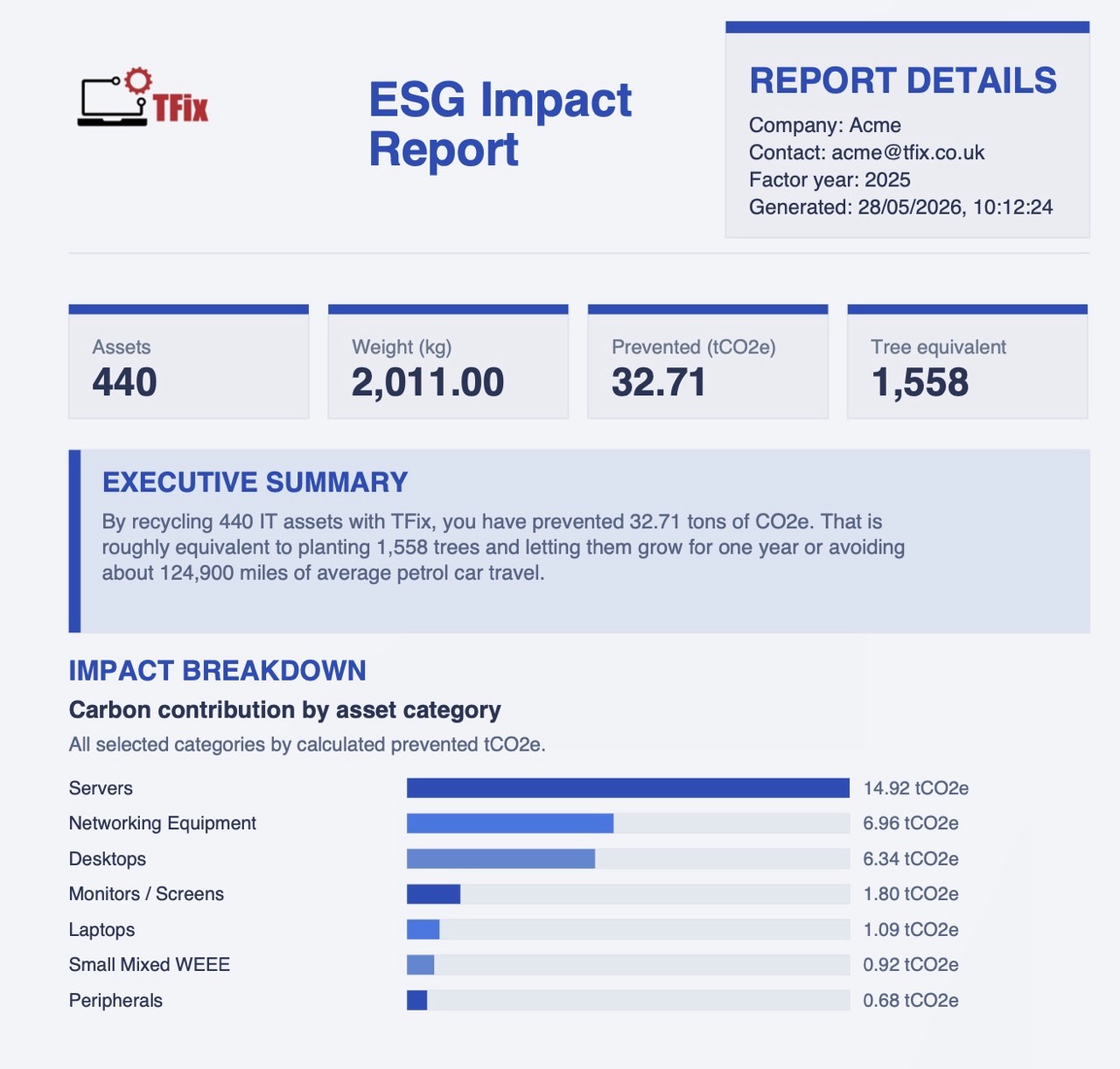
- Aggregate totals into tCO2e and equivalence outputs for quick decision support.
- Generate a branded PDF report for sharing, review, and record-keeping.
The result is still grounded in official source data, but usable without spreadsheet engineering work every time.
Methodology: Exactly What The Calculator Does
For each input row:
- Row weight (kg) = quantity x average unit weight (kg)
- Row carbon (kg CO2e) = row weight x mapped category factor (kg CO2e per kg)
Then:
- Total carbon (tCO2e) = sum of row carbon / 1000
- Tree equivalent = total kg CO2e / 21
Category factors are built from:
- Material-use factor rows (kg CO2e per tonne)
- Waste delta = landfill minus open-loop recycling rows (kg CO2e per tonne)
- Combined factor per kg = (material-use + waste delta) / 1000
Which Codes It Calculates Against
The current implementation uses the following government row identifiers:
Material-use rows
- IT:
19_503_5084_15_1(24865.47556) - Large appliances:
19_503_5080_15_1(3267.0) - Small appliances:
19_503_5088_15_1(5647.94563)
Waste treatment rows
- Large WEEE: open-loop
20_503_5323_15_1, landfill20_503_5327_15_1 - Mixed WEEE: open-loop
20_503_5330_15_1, landfill20_503_5334_15_1 - Small WEEE: open-loop
20_503_5337_15_1, landfill20_503_5341_15_1
Category mapping used in the tool
- Laptops: IT + Small WEEE delta
- Desktops: IT + Mixed WEEE delta
- Servers: IT + Large WEEE delta
- Monitors: Large appliance + Large WEEE delta
- Mobiles/Tablets: IT + Small WEEE delta
- Networking: IT + Mixed WEEE delta
- Peripherals: Small appliance + Small WEEE delta
- Small Mixed WEEE: Small appliance + Small WEEE delta
How To Use It In Real Reporting Workflows
A simple usage pattern is:
- Collect inventory by category, quantity, and average unit weight.
- Run the calculator and review category contributions.
- Download the generated report for internal distribution.
- Use the outputs in ESG updates, procurement decisions, and board-level summaries.
If your governance process requires annual reconciliation, align the output to your year-end reporting pack and control framework before final sign-off.
Final Word
Government factor resources are essential, but many teams need an operational layer between source data and practical reporting outputs. This calculator is that layer: transparent, mapped, and fast enough for real delivery workflows.
Try it here: UK WEEE and Carbon Calculator.
Ready to act on this?
Book a free ITAD assessment, compare your destruction options, or review provider-selection guidance before choosing a partner.
Need help with this in your organisation?
Book the matching service directly based on this article topic.